The Actual Distribution of Family Income in the United States Is Relatively Equal.
Chapter xiv. Poverty and Economical Inequality
14.4 Income Inequality: Measurement and Causes
Learning Objectives
By the terminate of this section, you volition be able to:
- Explain the distribution of income, and analyze the sources of income inequality in a marketplace economy
- Mensurate income distribution in quintiles
- Calculate and graph a Lorenz bend
- Show income inequality through demand and supply diagrams
Poverty levels can be subjective based on the overall income levels of a country; typically poverty is measured based on a per centum of the median income. Income inequality, still, has to do with the distribution of that income, in terms of which group receives the about or the least income. Income inequality involves comparison those with high incomes, middle incomes, and low incomes—not just looking at those below or near the poverty line. In turn, measuring income inequality ways dividing up the population into various groups and and so comparing the groups, a task that can be carried out in several ways, equally the next Clear It Up characteristic shows.
How do you split poverty and income inequality?
Poverty can change even when inequality does not move at all. Imagine a situation in which income for everyone in the population declines by 10%. Poverty would ascent, since a greater share of the population would at present fall below the poverty line. However, inequality would be the aforementioned, considering everyone suffered the aforementioned proportional loss. Conversely, a general rising in income levels over fourth dimension would keep inequality the same, but reduce poverty.
It is also possible for income inequality to change without affecting the poverty rate. Imagine a situation in which a large number of people who already take high incomes increment their incomes by even more. Inequality would rise as a result—merely the number of people below the poverty line would remain unchanged.
Why did inequality of household income increase in the United States in recent decades? Indeed, a trend toward greater income inequality has occurred in many countries around the globe, although the consequence has been more than powerful in the U.Due south. economic system. Economists take focused their explanations for the increasing inequality on two factors that changed more than or less continually from the 1970s into the 2000s. Ane set of explanations focuses on the changing shape of American households; the other focuses on greater inequality of wages, what some economists telephone call "winner have all" labor markets. We will brainstorm with how nosotros measure inequality, and so consider the explanations for growing inequality in the U.s..
Measuring Income Distribution by Quintiles
One common fashion of measuring income inequality is to rank all households by income, from lowest to highest, and and then to divide all households into five groups with equal numbers of people, known as quintiles. This calculation allows for measuring the distribution of income among the five groups compared to the full. The get-go quintile is the everyman 5th or 20%, the 2nd quintile is the side by side lowest, so on. Income inequality can exist measured by comparison what share of the total income is earned by each quintile.
U.S. income distribution by quintile appears in Table 7. In 2011, for example, the bottom quintile of the income distribution received three.ii% of income; the 2d quintile received 8.four%; the third quintile, 14.3%; the fourth quintile, 23.0%; and the pinnacle quintile, 51.14%. The terminal column of Table vii shows what share of income went to households in the pinnacle 5% of the income distribution: 22.3% in 2011. Over fourth dimension, from the belatedly 1960s to the early 1980s, the top fifth of the income distribution typically received between near 43% to 44% of all income. The share of income that the top fifth received then begins to rise. Co-ordinate to the Demography Bureau, much of this increase in the share of income going to the top fifth tin be traced to an increase in the share of income going to the top five%. The quintile measure out shows how income inequality has increased in contempo decades.
| Year | Everyman Quintile | Second Quintile | Third Quintile | 4th Quintile | Highest Quintile | Top 5% |
|---|---|---|---|---|---|---|
| 1967 | 4.0 | 10.8 | 17.3 | 24.2 | 43.half dozen | 17.2 |
| 1970 | 4.one | 10.viii | 17.iv | 24.5 | 43.three | 16.6 |
| 1975 | 4.3 | x.4 | 17.0 | 24.7 | 43.6 | 16.5 |
| 1980 | four.2 | 10.2 | 16.8 | 24.7 | 44.1 | 16.5 |
| 1985 | three.9 | 9.8 | 16.2 | 24.4 | 45.6 | 17.6 |
| 1990 | 3.8 | 9.6 | 15.ix | 24.0 | 46.half dozen | 18.v |
| 1995 | three.7 | 9.1 | 15.2 | 23.3 | 48.seven | 21.0 |
| 2000 | 3.6 | 8.9 | 14.eight | 23.0 | 49.8 | 22.1 |
| 2005 | iii.4 | eight.vi | xiv.6 | 23.0 | l.four | 22.2 |
| 2010 | 3.three | 8.5 | xiv.half-dozen | 23.iv | l.3 | 21.3 |
| 2013 | three.two | 8.4 | 14.4 | 23.0 | 51 | 22.2 |
| Tabular array 7. Share of Aggregate Income Received by Each Fifth and Height five% of Households, 1967–2013. (Source: U.S. Census Bureau, Tabular array 2) | ||||||
It can also be useful to divide the income distribution in ways other than quintiles; for example, into tenths or even into percentiles (that is, hundredths). A more detailed breakup can provide additional insights. For example, the concluding cavalcade of Table vii shows the income received past the top five% percent of the income distribution. Between 1980 and 2013, the share of income going to the peak 5% increased past 5.7 percent points (from 16.5% in 1980 to 22.2% in 2013). From 1980 to 2013 the share of income going to the meridian quintile increased by seven.0 percentage points (from 44.1% in 1980 to 51% in 2013). Thus, the superlative xx% of householders (the 5th quintile) received over one-half (51%) of all the income in the United States in 2013.
Lorenz Curve
The information on income inequality can exist presented in various ways. For example, you could draw a bar graph that showed the share of income going to each fifth of the income distribution. Effigy 1 presents an alternative way of showing inequality information in what is called a Lorenz bend. The Lorenz curve shows the cumulative share of population on the horizontal axis and the cumulative percentage of total income received on the vertical centrality.
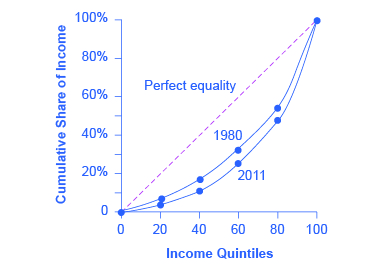
Every Lorenz curve diagram begins with a line sloping up at a 45-degree angle, shown as a dashed line in Figure 1. The points forth this line testify what perfect equality of the income distribution looks like. Information technology would hateful, for case, that the bottom twenty% of the income distribution receives 20% of the total income, the bottom 40% gets 40% of total income, and then on. The other lines reflect actual U.Due south. data on inequality for 1980 and 2011.
The play tricks in graphing a Lorenz curve is that you must alter the shares of income for each specific quintile, which are shown in the starting time column of numbers in Table 8, into cumulative income, shown in the second column of numbers. For example, the bottom xl% of the cumulative income distribution will exist the sum of the first and second quintiles; the bottom lx% of the cumulative income distribution will be the sum of the first, 2nd, and third quintiles, and so on. The final entry in the cumulative income cavalcade needs to be 100%, because by definition, 100% of the population receives 100% of the income.
| Income Category | Share of Income in 1980 (%) | Cumulative Share of Income in 1980 (%) | Share of Income in 2013 (%) | Cumulative Share of Income in 2013 (%) |
|---|---|---|---|---|
| Get-go quintile | iv.2 | 4.ii | 3.two | 3.2 |
| Second quintile | 10.2 | 14.4 | 8.4 | 11.6 |
| Third quintile | xvi.8 | 31.two | 14.4 | 26.0 |
| Fourth quintile | 24.7 | 55.9 | 23.0 | 49.0 |
| 5th quintile | 44.ane | 100.0 | 51.0 | 100.0 |
| Table 8. Calculating the Lorenz Bend | ||||
In a Lorenz curve diagram, a more than unequal distribution of income will loop further downward and abroad from the 45-degree line, while a more equal distribution of income will move the line closer to the 45-degree line. The greater inequality of the U.S. income distribution between 1980 and 2013 is illustrated in Figure 1 considering the Lorenz curve for 2013 is farther from the 45-degree line than the Lorenz bend for 1980. The Lorenz bend is a useful fashion of presenting the quintile data that provides an image of all the quintile information at once. The next Clear It Upward feature shows how income inequality differs in diverse countries compared to the United states.
How does economic inequality vary around the world?
The U.S. economy has a relatively high degree of income inequality past global standards. As Table 9 shows, based on a multifariousness of national surveys done for a selection of years in the last v years of the 2000s (with the exception of Germany, and adjusted to make the measures more comparable), the U.S. economy has greater inequality than Germany (along with most Western European countries). The region of the world with the highest level of income inequality is Latin America, illustrated in the numbers for Brazil and Mexico. The level of inequality in the Usa is lower than in some of the low-income countries of the world, like China and Nigeria, or some middle-income countries like the Russian federation. However, not all poor countries have highly diff income distributions; Republic of india provides a counterexample.
| State | Survey Year | Outset Quintile | 2nd Quintile | Third Quintile | Fourth Quintile | Fifth Quintile |
|---|---|---|---|---|---|---|
| United states of america | 2013 | 3.two% | 8.iv% | xiv.4% | 23.0% | 51.0% |
| Federal republic of germany | 2000 | viii.5% | 13.7% | 17.viii% | 23.1% | 36.ix% |
| Brazil | 2009 | 2.ix% | 7.i% | 12.iv% | 19.0% | 58.vi% |
| Mexico | 2010 | 4.9% | 8.eight% | 13.three% | 20.2% | 52.eight% |
| China | 2009 | 4.7% | nine.vii% | 15.3% | 23.2% | 47.1% |
| Bharat | 2010 | 8.five% | 12.ane% | 15.7% | 20.eight% | 42.eight% |
| Russia | 2009 | 6.1% | 10.iv% | 14.8% | 21.three% | 47.ane% |
| Nigeria | 2010 | iv.iv% | 8.3% | thirteen.0% | xx.three% | 54.0% |
| Table 9. Income Distribution in Select Countries. (Source: U.South. data from U.S. Census Bureau Table ii. Other data from The Globe Banking company Poverty and Inequality Information Base, http://databank.worldbank.org/data/views/reports/tableview.aspx#) | ||||||
Visit this website to watch a video of wealth inequality across the world.

Causes of Growing Inequality: The Changing Composition of American Households
In 1970, 41% of married women were in the labor force, but by 2015, according to the Bureau of Labor Statistics, 56.7% of married women were in the labor force. Ane result of this trend is that more households have two earners. Moreover, it has get more common for 1 high earner to marry another high earner. A few decades ago, the common pattern featured a man with relatively high earnings, such as an executive or a dr., marrying a woman who did non earn as much, similar a secretary or a nurse. Oftentimes, the woman would go out paid employment, at least for a few years, to enhance a family. However, now doctors are marrying doctors and executives are marrying executives, and mothers with loftier-powered careers are often returning to work while their children are quite immature. This pattern of households with two high earners tends to increase the proportion of high-earning households.
According to data in the National Journal, even as two-earner couples accept increased, so take unmarried-parent households. Of all U.Southward. families, thirteen.1% were headed past single mothers; the poverty rate among unmarried-parent households tends to be relatively high.
These changes in family construction, including the growth of single-parent families who tend to exist at the lower terminate of the income distribution, and the growth of two-career high-earner couples most the top end of the income distribution, account for roughly half of the ascension in income inequality across households in recent decades.
Visit this website to watch a video that illustrates the distribution of wealth in the The states.

Causes of Growing Inequality: A Shift in the Distribution of Wages
Another factor behind the rise in U.South. income inequality is that earnings have go less equal since the late 1970s. In particular, the earnings of high-skilled labor relative to low-skilled labor accept increased. Winner-take-all labor markets result from changes in technology, which have increased global need for "stars,"—whether the best CEO, medico, basketball game player, or actor. This global demand pushes salaries far above productivity differences versus educational differences. 1 manner to measure this change is to accept the earnings of workers with at least a iv-year college bachelor'southward degree (including those who went on and completed an advanced degree) and divide them past the earnings of workers with only a high school degree. The result is that those in the 25–34 historic period bracket with college degrees earned about 1.67 times every bit much as high school graduates in 2010, up from 1.59 times in 1995, according to U.S. Census information. Winner-take-all labor market theory argues that the salary gap between the median and the superlative 1 per centum is not due to educational differences.
Economists employ the demand and supply model to reason through the most likely causes of this shift. Co-ordinate to the National Eye for Education Statistics, in contempo decades, the supply of U.Southward. workers with college degrees has increased substantially; for example, 840,000 four-year available'southward degrees were conferred on Americans in 1970; in 2009–2010, 1,602,480 such degrees were conferred—an increase of about xc%. In Figure ii, this shift in supply to the correct, from South0 to Sane, should result in a lower equilibrium wage for high-skilled labor. Thus, the increase in the toll of high-skilled labor must be explained by a greater need, like the movement from D0 to D1. Evidently, combining both the increase in supply and in demand has resulted in a shift from Eastward0 to Eastward1, and a resulting higher wage.
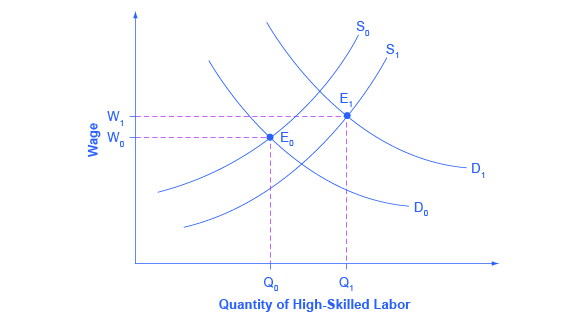
What factors would cause the demand for high-skilled labor to rise? The virtually plausible explanation is that while the explosion in new information and communications technologies over the concluding several decades has helped many workers to become more productive, the benefits take been particularly great for high-skilled workers like top business organization managers, consultants, and design professionals. The new technologies have too helped to encourage globalization, the remarkable increase in international merchandise over the last few decades, by making it more possible to learn about and coordinate economic interactions all around the world. In turn, the ascent touch of foreign trade in the U.Due south. economy has opened up greater opportunities for high-skilled workers to sell their services around the world. And lower-skilled workers have to compete with a larger supply of similarly skilled workers effectually the globe.
The market for loftier-skilled labor can be viewed as a race between forces of supply and demand. Additional educational activity and on-the-job training will tend to increase the supply of high-skilled labor and to hold down its relative wage. Conversely, new technology and other economic trends like globalization tend to increase the demand for high-skilled labor and push up its relative wage. The greater inequality of wages can be viewed every bit a sign that demand for skilled labor is increasing faster than supply. On the other manus, if the supply of lower skilled workers exceeds the demand, and so average wages in the lower quintiles of the income distribution will decrease. The combination of forces in the high-skilled and low-skilled labor markets leads to increased income disparity.
Key Concepts and Summary
Measuring inequality involves making comparisons beyond the entire distribution of income, not only the poor. One mode of doing this is to divide the population into groups, similar quintiles, and so calculate what share of income is received by each group. An culling approach is to draw Lorenz curves, which compare the cumulative income actually received to a perfectly equal distribution of income. Income inequality in the Usa increased substantially from the late 1970s and early 1980s into the 2000s. The two most common explanations cited past economists are changes in the construction of households that have led to more two-earner couples and single-parent families, and the effect of new information and communications technology on wages.
Self-Check Questions
- A grouping of 10 people have the post-obit almanac incomes: $24,000, $18,000, $50,000, $100,000, $12,000, $36,000, $eighty,000, $10,000, $24,000, $16,000. Calculate the share of total income received by each quintile of this income distribution. Practise the top and bottom quintiles in this distribution have a greater or larger share of full income than the top and bottom quintiles of the U.S. income distribution?
- Table 10 shows the share of income going to each quintile of the income distribution for the United kingdom in 1979 and 1991. Use this information to calculate what the points on a Lorenz bend would exist, and sketch the Lorenz curve. How did inequality in the U.k. shift over this time period? How can you see the patterns in the quintiles in the Lorenz curves?
Share of Income 1979 1991 Elevation quintile 39.vii% 42.9% Quaternary quintile 24.8% 22.seven% Middle quintile 17.0% 16.3% 2nd quintile xi.5% 11.5% Bottom quintile 7.0% 6.6% Table 10. Income Distribution in the Great britain, 1979 and 1991 - Using ii need and supply diagrams, one for the low-wage labor market and i for the loftier-wage labor market, explain how information engineering science tin can increase income inequality if it is a complement to loftier-income workers like salespeople and managers, but a substitute for low-income workers similar file clerks and telephone receptionists.
- Using two need and supply diagrams, one for the low-wage labor marketplace and i for the high-wage labor market, explain how a program that increased educational levels for a substantial number of depression-skill workers could reduce income inequality.
Review Questions
- Who is included in the pinnacle income quintile?
- What is measured on the two axes of a Lorenz curve?
- If a country had perfect income equality what would the Lorenz bend look similar?
- How has the inequality of income changed in the U.S. economy since the belatedly 1970s?
- What are some reasons why a sure degree of inequality of income would exist expected in a marketplace economic system?
- What are the main reasons economists requite for the increase in inequality of incomes?
Critical Thinking Questions
- Explicate how a country may feel greater equality in the distribution of income, yet still experience high rates of poverty Hint: Look at the Articulate It Upwards "How is poverty measured in low-income countries?" and compare to Tabular array 7.
- The demand for skilled workers in the United States has been increasing. To increment the supply of skilled workers, many debate that immigration reform to allow more skilled labor into the United States is needed. Explain whether you lot agree or disagree.
- Explain a situation using the supply and demand for skilled labor in which the increased number of college graduates leads to depressed wages. Given the rise cost of going to college, explain why a college didactics volition or will not increase income inequality.
Problems
A group of x people have the following annual incomes: $55,000, $30,000, $15,000, $20,000, $35,000, $80,000, $40,000, $45,000, $xxx,000, $50,000. Calculate the share of full income received by each quintile of this income distribution. Do the tiptop and bottom quintiles in this distribution take a greater or larger share of total income than the pinnacle and bottom quintiles of the U.Southward. income distribution for 2005?
References
Frank, Robert H., and Philip J. Cook. The Winner-Take-All Social club. New York: Martin Kessler Books at The Complimentary Press, 1995.
Found of Didactics Sciences: National Center for Education Statistics. "Fast Facts: Degrees Conferred past Sex and Race." http://nces.ed.gov/fastfacts/brandish.asp?id=72.
Nhan, Doris. "Census: More in U.S. Written report Nontraditional Households." National Journal. Last modified May i, 2012. http://www.nationaljournal.com/thenextamerica/demographics/census-more-in-u-due south-study-nontraditional-households-20120430.
U.Southward. Bureau of Labor Statistics: BLS Reports. "Report 1040: Women in the Labor Force: A Databook." Terminal modified March 26, 2013. http://www.bls.gov/cps/wlf-databook-2012.pdf.
U.S. Department of Commerce: U.s.a. Census Bureau. "Income: Table H-ii. Share of Aggregate Income Received past Each Fifth and Summit 5 Pct of Households." http://www.census.gov/hhes/www/income/data/historical/household/.
United States Census Bureau. 2014. "2013 Highlights." Accessed April thirteen, 2015. http://www.census.gov/hhes/www/poverty/about/overview/.
United States Census Bureau. 2014. "Historical Income Tables: Households: Table H-2 Share of Aggregate Income Received by Each 5th and Top 5% of Income. All Races." Accessed April 13, 2015. http://www.demography.gov/hhes/www/income/information/historical/household/.
Glossary
- Lorenz curve
- a graph that compares the cumulative income actually received to a perfectly equal distribution of income; it shows the share of population on the horizontal axis and the cumulative pct of total income received on the vertical centrality
- quintile
- dividing a group into fifths, a method often used to look at distribution of income
Solutions
Answers to Self-Check Questions
- A useful first step is to rank the households by income, from lowest to highest. And so, since at that place are ten households total, the bottom quintile volition be the bottom two households, the second quintile will be the third and quaternary households, and and so on upwards to the acme quintile. The quintiles and percentage of total income for the information provided are shown in the following table. Comparing this distribution to the U.South. income distribution for 2005, the superlative quintile in the example has a smaller share of total income than in the U.S. distribution and the lesser quintile has a larger share. This pattern usually means that the income distribution in the example is more equal than the U.S. distribution.
Income Quintile % of Total Income $ten,000 Total offset quintile income: $22,000 vi.0% $12,000 $16,000 Full second quintile income: $34,000 ix.2% $xviii,000 $24,000 Total third quintile income: $48,000 13.0% $24,000 $36,000 Total fourth quintile income: $86,000 23.2% $50,000 $fourscore,000 Total meridian quintile income: $180,000 48.six% $100,000 $370,000 Total Income Table 11. - Just from glancing at the quintile information, it is adequately obvious that income inequality increased in the Britain over this time: The pinnacle quintile is getting a lot more, and the everyman quintile is getting a bit less. Converting this information into a Lorenz curve, all the same, is a fiddling trickier, because the Lorenz curve graphs the cumulative distribution, not the corporeality received past individual quintiles. Thus, as explained in the text, you have to add up the individual quintile data to convert the data to this grade. The following table shows the actual calculations for the share of income in 1979 versus 1991. The effigy following the tabular array shows the perfect equality line and the Lorenz curves for 1979 and 1991. Equally shown, the income distribution in 1979 was closer to the perfect equality line than the income distribution in 1991—that is, the Uk income distribution became more unequal over time.
Share of income received 1979 1991 Bottom xx% 7.0% half-dozen.half-dozen% Bottom 40% 18.5% 18.1% Bottom 60% 35.5% 34.4% Bottom 80% threescore.3% 57.1% All 100% 100.0% 100.0% Table 12. 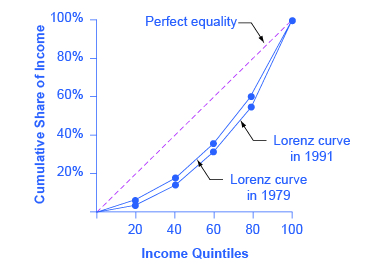
Figure 3. - In the market for low-wage labor, it shifts the demand for low-wage labor to the left. One reason is that technology can often substitute for depression-wage labor in certain kinds of phone or accounting jobs. In addition, information technology makes information technology easier for companies to manage connections with depression-wage workers in other countries, thus reducing the demand for low-wage workers in the United states. In the market for high-wage labor, data technology shifts the demand for high-wage labor to the right. By using the new information and communications technologies, high-wage labor can become more productive and can oversee more tasks than before. The following figure illustrates these two labor markets. The combination of lower wages for low-wage labor and college wages for high-wage labor means greater inequality.
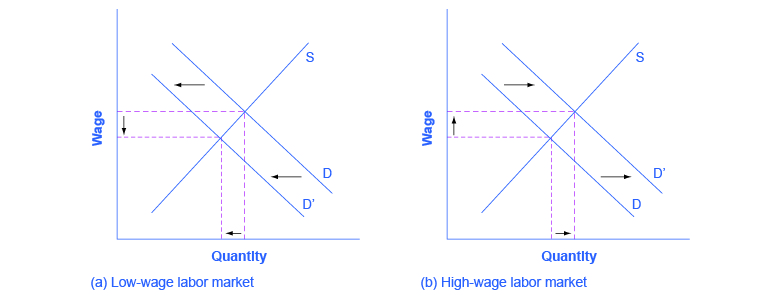
Figure 4. - In the market for low-wage labor, a skills program volition shift supply to the left, which will tend to drive up wages for the remaining depression-skill workers. In the marketplace for high-wage labor, a skills program will shift supply to the right (because after the preparation plan there are at present more high-skilled workers at every wage), which will tend to bulldoze downwardly wages for high-skill workers. The combination of these two programs volition result in a lesser caste of inequality. The following effigy illustrates these two labor markets. In the marketplace for high-wage labor, a skills program volition shift supply to the right, which will tend to drive down wages for high-skill workers.
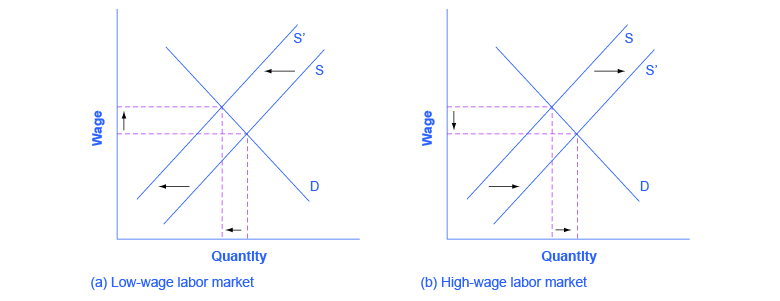
Effigy five.
Source: https://opentextbc.ca/principlesofeconomics/chapter/14-4-income-inequality-measurement-and-causes/

Post a Comment for "The Actual Distribution of Family Income in the United States Is Relatively Equal."