Large scale Amphibious Operations Will Never Occur Again Omar Bradley

The "Revolt of the Admirals" was a policy and funding dispute inside the United States government during the Cold State of war in 1949, involving a number of retired and active-duty United States Navy admirals. These included serving officers Admiral Louis E. Denfeld, Principal of Naval Operations, and Vice Admiral Gerald F. Bogan, every bit well equally Fleet Admirals Chester Nimitz and William Halsey, senior officers in World State of war II.
The episode occurred at a time when President Harry Southward. Truman and Secretarial assistant of Defense Louis A. Johnson were seeking to reduce military expenditure. This policy involved deep cuts in the Navy, while making the The states Air Force and strategic nuclear bombing the primary means of defending American interests. The Navy sought to cleave out a part for itself in strategic bombing, which the Air Force saw equally 1 of its primary roles.
Partly driven by inter-service rivalry, the argue escalated from differences over strategy to the question of civilian command over the military. The cancellation of the aircraft carrier USSU.s. and accusations of impropriety past Johnson in regard to the purchase of the Convair B-36 Peacemaker bomber led to an investigation by the Firm Committee on Armed services chaired by Carl Vinson.
While the dispute was settled in favor of the Truman assistants, the outbreak of the Korean War in June 1950 demonstrated the shortcomings of a defense policy primarily reliant on nuclear weapons, and many of the proposed cuts to conventional forces were ultimately reversed.
Background [edit]
Military unification [edit]
During Globe War II, at that place existed broad wartime presidential authorisation to reorganize the armed forces nether the War Powers Deed of 1941, just this authority was due to elapse six months later the terminate of the war, and then in April 1944, the Us Congress began considering legislation for post-war system. In response, the Joint Chiefs of Staff, the wartime body consisting of the most senior uniformed leaders, decided that it would need to set a submission, every bit the system of the Joint Chiefs of Staff and its various advisory committees were themselves advertizement hoc wartime creations. On 9 May 1944, it appointed a Special Committee for Reorganization of National Defense nether the chairmanship of Admiral James O. Richardson, a one-time Commander in Chief, United States Fleet, consisting of Major General William F. Tompkins from the War Department General Staff, Major General Harold L. George from the USAAF, Rear Admiral Malcolm F. Schoeffel and Colonel F. Trubee Davison, a former Assistant Secretary of State of war for Air.[1] [two]

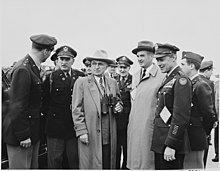
Summit officials of the National Military Establishment run into in Fundamental Westward, Florida in March 1948. Front row, left to right: from left to right, are: Admiral Louis E. Denfeld, USN, Chief of Naval Operations; Fleet Admiral William D. Leahy, USN, Chief of Staff to the Commander in Master; James Forrestal, Secretary of Defense; General Carl Spaatz, USAF, Chief of Staff of the Air Force; and General Omar North. Bradley, USA, Chief of Staff of the Regular army
The commission reported to the Joint Chiefs of Staff on 11 Apr 1945. It endorsed the unification of the War and Navy Departments into a single department of armed forces headed past a civilian secretarial assistant, with three equal services through the cosmos of an independent air strength. During the war United States Army Air Forces (USAAF) had accomplished a degree of de facto independence from the United States Army, and was eager to become a fully-fledged armed service on an equal footing with the Army and the United states Navy. Richardson dissented, favoring the status quo over the creation of a new department, only he accustomed the proposal to perpetuate the arrangement of the Joint Chiefs of Staff by statute.[ane] [3]
Senior Navy officers including Armada Admirals William D. Leahy (the Master of Staff to the Commander in Chief), Ernest J. King (the Commander in Chief, United States Armada) and Chester W. Nimitz (the Commander in Principal, US Pacific Fleet) regarded the commission's recommendations equally radical. They opposed the thought of a single secretary of National Defence force, which they felt was also much responsibility for ane homo, and it interposed a noncombatant head between the Articulation Chiefs of Staff and the President of the United States, which might diminish the Navy's ability and influence. They also feared the possible loss of the Navy'due south air arm, as had happened to the Imperial Navy when the Royal Naval Air Service was absorbed into the Imperial Air Force upon the cosmos of the latter in 1918.[1] [3]
The Senate Committee on Armed services Affairs formed a subcommittee to draft legislation, with Major General Lauris Norstad, the Assistant Chief of the Air Staff of Plans, and Rear Admiral Arthur W. Radford, the Deputy Chief of Naval Operations (DCNO) for Air, as its advisors. Radford was considered a hard liner in his opposition to unification even inside the Navy, and in July 1946, James Forrestal, the Secretarial assistant of the Navy, and Nimitz, at present the Chief of Naval Operations (CNO), replaced him with the DCNO for Operations, Rear Admiral Forrest Sherman. Although also a naval aviator, Sherman did not oppose unification. He and Norstad drew up an agreement that was endorsed by the Joint Chiefs of Staff and forwarded to the President, Harry S. Truman, for approving on 12 December 1946.[4]
This became the basis for the National Security Act of 1947,[5] which created the National Security Council (NSC), Central Intelligence Agency (CIA), an contained United states of america Air Force (USAF), 3 civilian war machine department heads, and the National Armed forces Establishment, a unified control with a cabinet-level Secretary of Defence to oversee the service departments and the Joint Chiefs of Staff.[iii] [6] The Human action left the Navy with the autonomy it sought, and control of its own Naval and Marine Corps Aviation, effectively legitimizing four military air forces. The act appeared to end the contend, although none of the services was completely happy with it.[seven]
Forrestal, a former naval aviator who had led the fight against unification, was appointed the showtime Secretary of Defense;[8] John L. Sullivan, formerly the Assistant Secretary of the Navy (AIR) succeeded him equally Secretary of the Navy;[9] Kenneth C. Royall, the Nether Secretary of War, became the Secretary of the Army; and Stuart Symington, who had been the Banana Secretary of War for Air, became the first Secretary of the Air Force.[10] As the Navy had wanted, the Secretarial assistant of Defense had a coordination role, and lacked the say-so and resources to exercise effective control over service departments and their chiefs.[iii] [10] Forrestal hoped that with unification accomplished, the services would fix aside their parochial differences.[xi]
Budgets and strategy [edit]

Following the stop of World State of war II, the Usa Regime was concerned near the large deficit spending that had been necessary for the war endeavor, which reached 119 percent of the gross domestic product (Gross domestic product) in 1946. Arrears spending had lifted the United States out of the Corking Depression, but now Truman and his economic advisors were concerned about the prospect of aggrandizement, which rose to 14.4 pct in 1947 afterwards wartime toll controls were removed, and embraced thrift. To reduce expenditures, the armed services had to quickly demobilize and return to a peacetime military. Defense budgets declined from $81 billion in fiscal year 1945 (equivalent to $940 billion in 2020) to $9 billion in fiscal year 1948 (equivalent to $79 billion in 2020), representing a refuse from 37.5 percent of GDP to 3.five percent.[12] The services were reduced from 89 army and vi marine divisions to 12;[thirteen] [14] from 213 air groups to 63 (only xi of which were operational, with some existing only on paper);[14] [xv] and from 1,166 warships to 343.[14] Meanwhile, $13 billion went into the Marshall Plan, which commenced in 1948.[12]
US war plans were drafted for a potential conflict with the Soviet Union. Information technology was considered unlikely that the Soviet Union wanted to start a war, simply the plans were prepared for the possibility that one might pause out every bit a issue of a miscalculation. The Soviet Union had 50 divisions in Germany and Austria to the US Regular army's one, plenty to apace overrun Europe east of the Rhine. This was a major bulwark, but it was not considered that information technology could be held for long, forcing a retreat to the Pyrenees. In view of the Soviet Union's overwhelming superiority in conventional forces, the planners felt that the United states had no alternative ways of hitting back other than a strategic air offensive employing both conventional and nuclear weapons.[16]
Admiral Louis East. Denfeld, who had succeeded Nimitz as CNO on xv Dec 1947,[17] was critical of the war plan, which he regarded as deeply flawed. He noted that abandoning Western Europe without a struggle ran counter to the United states Government policy of building up the democracies there, and it meant accepting the loss of the Mediterranean Sea too. The plan called for using the Karachi expanse as a base for the strategic air campaign, but this would involve an enormous logistical endeavour to sustain, and it would non support other elements of the state of war program. Moreover, there was no fallback in case the strategic bombing campaign failed. He was willing to sign off on the plan simply as a temporary i for short-range planning, and advocated a more than aggressive strategy in which the Rhine and Middle East were held.[xviii] None of the three services had the resources to implement the brusque-term war program, much less the more ambitious one.[nineteen]
Strategic bombing [edit]
In the years leading up to World War Ii, the United States Army Air Corps had developed a doctrine of strategic air battery, which was promulgated by the Air Corps Tactical School.[20] The feel of strategic bombing during World War II revealed major flaws in the Air Corps' precision bombing doctrine. Unescorted bombers were found to be highly vulnerable to fighters, and took loftier losses. Improvements in anti-aircraft guns collection the bombers to college altitudes, from which authentic bombing was difficult. None of the chief targets of the bombing offensive in Europe was destroyed or even suffered severe disruption, and only the oil campaign was ultimately regarded as successful.[21] Air raids on Japan encountered conditions and flying conditions that made daylight precision bombing from high altitude fifty-fifty more difficult than in Europe, resulting in a switch of tactics to low-level surface area bombing of cities with incendiaries.[22] The wartime Chief of the USAAF, Full general of the Army Henry H. Arnold, contended that the conventional bombing had destroyed Japan's ability to wage war, and the atomic bombing of Hiroshima and Nagasaki had given the Emperor of Japan an excuse to finish the war.[23]
The advent of nuclear weapons gave the strategic battery theorists encouragement that the factors that had limited the effectiveness of strategic bombing during the war could be overcome.[24] Colonel Dale O. Smith wrote that:
[T]he virtually effective air siege will result by concurrently attacking every critical element of the enemy'due south economic system at the aforementioned time. This volition result in a full general disintegration of all manufacture that volition, in plough, prevent reconstruction. Oil, transportation, power, vital end products, and weapon factories, if destroyed meantime, would leave a nation in such a devastated state as to preclude repair, since the capability for repair would take been lost also. When our bombs were constructed of puny TNT this concept was questionable because we did not have sufficient power and nosotros were forced to look for panacea targets, Achilles' heels, and short cuts ... If all the disquisitional industrial systems could be destroyed at one blow, so that recuperation were impossible within any foreseeable time, in that location seems little question only that a nation would die just as surely as a human being will die if a bullet pierces his eye and his circulatory system is stopped.[25] [26]
The bombing campaign called for in the war plans was both nuclear and conventional. By June 1948, components for about l Fat Man and two Little Boy bombs were on hand.[27] These had to be assembled by specially trained Military Special Weapons Project assembly teams.[28] Only Silverplate Boeing B-29 Superfortress bombers were capable of delivering nuclear weapons, and of the 65 that had been fabricated, only 32 were operational at the start of 1948, all of which were assigned to the 509th Bombardment Grouping, which was based at Roswell Army Airfield in New Mexico.[29] [30] Trained crews were also in short supply; at the beginning of 1948 only half dozen crews were qualified to fly atomic bombing missions, although enough personnel had been trained to gather an additional xiv in an emergency.[31] But upward to 20 percent of the target cities in the war plan were beyond the 3,000-nautical-mile (5,600 km) range of the B-29, requiring a one-fashion mission, which would expend the crew, flop and aircraft.[32] [33] There were as well doubts about the ability of the B-29 to penetrate Soviet air space; as a propeller-driven bomber, information technology was highly vulnerable to the new Soviet jet fighters, even at dark.[34]
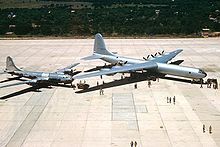
The B-29 was the mainstay of the bomber fleet in 1948, just that year the Convair B-36 Peacemaker was introduced into service.[35] German victories in the early office of World State of war II had led to apprehension that the United Kingdom might be overrun. The Air Corps therefore invited design proposals for an intercontinental bomber that could reach Deutschland from bases in the United States. From this came the B-36. The aircraft pushed the state of the art at the fourth dimension, but shortly ran into development and schedule problems, and lost priority to the B-29.[36] Information technology was not canceled, and in 1943 when it looked like bases in Communist china — the simply ones in Centrolineal hands at the time inside B-29 range of Japan — might be overrun, an order was placed for 100 B-36s. Most aircraft orders were cut back or canceled in 1945, just the B-36 club was left untouched.[37]
Many air forcefulness officers were skeptical of the value of the B-36,[38] but in tests conducted between Apr and June 1948, the B-36 outperformed the Boeing B-l Superfortress, the improved model of the B-29, in long-range cruising speed, load capacity and combat radius. The beginning of the Berlin Blockade in June 1948 led to increased concerns well-nigh the ambitious stance taken by the Soviet Union, and demands for an intercontinental bomber.[39] The B-36 was not yet atomic capable; deliveries of atomic-capable B-36s commenced in 1949.[35] In service, information technology suffered from a host of problems, every bit was usual for new shipping. An intrinsic ane was that it was a piston-engine aircraft in the era of jets. It was therefore accepted as an acting aircraft, awaiting the introduction of the jet Boeing B-52 Stratofortress, but this was not expected to occur before 1952.[40]
The 80th Congress adjourned in August 1948 without passing a bill authorizing a 70-grouping peacetime air forcefulness, just the Chief of Staff of the Air Force, General Hoyt Vandenberg, took the provision of a first increment of funds for the purpose equally a mandate, and commenced the acquisition process for the 2,201 shipping required with the funds on hand. This included the remaining 95 B-36s from the original contract, forth with x of the new Boeing B-47 Stratojet bombers, 132 B-50s, 1,457 jet fighters and 147 transport planes. In 1948, the services began preparing their upkeep submissions for fiscal year 1950. The Air Staff requested $viii billion, which would cover the 70-group program. But after word got around that budgets would be cut proportionately, Symington arbitrarily increased the submission to $11 billion.[41] The resulting service requests, when tallied in July, came to $29 billion.[42]
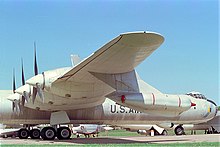
Late model B-36 with jet pods
There was no reason to believe that this would be available. The Bureau of the Upkeep had originally forecast a $5 billion surplus in fiscal year 1950, but the recession of 1949, resulted in a drib in revenue and a revised forecast of a $2 billion deficit.[41] Forrestal cut the defence request to $23.6 billion in Oct 1948,[42] but the Agency of the Upkeep convinced Truman to set a $xiv.4 billion ceiling on defense expenditure in financial year 1950. The Joint Chiefs estimated that in the outcome of a war, this would reduce the U.s. reaction to a strategic bombing offensive from the United Kingdom. The Joint Chiefs of Staff divided the $14.four billion between the three services, giving $4.834 billion to the Regular army, $iv.624 billion to the Navy, and $5.025 billion to the Air Force.[41]
This meant that the air forcefulness would have to cut back to only 48 groups. Vandenberg convened a senior officers' board chaired by General Joseph T. McNarney to determine an appropriate structure. It decided to reduce the Strategic Air Command to 14 bombardment groups. Its commander Lieutenant Full general Curtis LeMay, stated that the diminutive mission required four groups of bombers, which he said should be equipped with B-36s. The B-36 could cover 97 percent of targets in the Soviet Union from bases in North America, and in the conventional office information technology could comport 43 brusque tons (39 t) of bombs over medium distances. He endorsed a proposal to meliorate the functioning of the B-36 by adding twin jet pods (B-47 jet engines). Of the remaining ten bombardment groups, 5 would exist equipped with B-50s, two with the new B-47s, and three with B-29s. The B-36 program actually benefited from the cutbacks, because $269,761,000 was recouped from the counterfoil of orders for other shipping. LeMay also recommended that the Boeing B-54, an improved version of the B-50, be canceled and the funds used to purchase 36 more B-36s and five more B-47s. Forrestal signed off on this recertification of funds in March 1949. That month the lath as well recommended that B-36 acquisition exist limited to what was required for four groups, after which production would be switched over to the B-52.[43]
Shipping carriers [edit]
The Navy had no theoretical framework with which to develop a post-war strategy. Between 1890 and 1945 its doctrine had been based on the teachings of Alfred Thayer Mahan, who stressed the importance of control of the sea in securing the lines of communication through which maritime commerce traveled, and argued that the main objective of a Navy was the destruction of the enemy's battle armada. But the Soviet Wedlock had only a small-scale navy, and every bit a Eurasian power, it was not dependent on maritime trade, and thus was immune to the effects of a naval blockade.[44] [45] Beingness in third place for funding behind the Regular army and Air Force represented a major loss of status for the Navy, which had traditionally seen itself every bit the nation's commencement line of defense. The Navy'southward budget had exceeded the Army's for every twelvemonth but 1 between 1922 and 1939. Information technology enjoyed the support of President Franklin D. Roosevelt, and had its own secretary who reported directly to him.[46] The Navy had cultivated political patronage in Congress past dispersing construction and maintenance of its vessels effectually the nation, and the House Committee on Naval Affairs and the Senate Committee on Naval Affairs had supported the acquisition of expensive capital ships and the development of naval aviation.[46] [47]

The United states of america Navy had caused its first aircraft carriers in 1922, when it deputed a converted collier as the USSLangley. Carriers accompanied the armada, and the aircraft had the roles of scouting, ascertainment and attacking enemy vessels.[48] Between 1910 and 1930, around xx percentage of all naval officers went into naval aviation. These included Forrest Sherman, Arthur Radford, Gerald F. Bogan and Daniel V. Gallery, all of whom rose to flag rank in the wartime Navy. Crucially, and in contrast to the Army, where corps loyalty was paramount, the Navy inculcated the mental attitude that every officer was a naval officer first and a specialist second. This was bolstered by a long-standing ethos of creating a "balanced armada", in which all specialists played a part. While some naval aviators became zealous advocates of naval air power, they expressed no want to carve up from the Navy.[49]
To operate from carriers, aircraft needed tailhooks and strengthened undercarriages, which fabricated them heavier and less maneuverable than similar state-based aircraft,[48] but fears that they could not compete against state-based fighters proved ultimately baseless; between ane September 1944 and 15 August 1945, US Navy Grumman F6F Hellcat and Vought F4U Corsair fighters downed ii,948 Japanese fighters against a loss of 191 of their ain.[50] However, like strategic bombing, the record of shipping carriers was non as clear cutting every bit the enthusiasts suggested.[51] Just ii battleships were sunk by US carrier shipping alone: the giant Yamato and Musashi. US carrier aircraft accounted for 4 of the 18 Japanese heavy cruisers that were sunk, 6 of the 25 light cruisers, and 27 of the 127 destroyers. What they were particularly lethal against was other aircraft carriers, sinking 11 of the 19 Japanese carriers sunk in the war.[52] In the mail service-war drawdown, the aircraft carrier fleet was reduced to the three Midway-class and eight Essex-class.[53]
One role the Navy could play in a conflict with the Soviet Union was participation in strategic bombing. In December 1947, Gallery wrote a top-cloak-and-dagger memorandum on the subject area.[54] The idea was that instead of edifice a bomber with a range of v,000 nautical miles (9,300 km; v,800 mi), Gallery argued that it was a better idea to build ane with bottom range that could be launched from an shipping carrier.[55] Radford noted that any target in the world was within 1,500 nautical miles (2,800 km; 1,700 mi) of the ocean. A carrier could be deployed rapidly in a crisis, and did not require the institution of expensive overseas bases.[56] Gallery even went further than most Navy officers in arguing that strategic bombing with nuclear weapons should be the primary mission of the Navy.[54] In forwarding the memo to Sullivan, Denfeld wrote: "I not merely consider Rear Admiral Gallery'south initiative in preparing the paper was commendable and proper, but that the paper itself demonstrates the type of constructive thinking that the Navy tries at all times to encourage."[57] The memo was leaked to a syndicated newspaper columnist, Drew Pearson, who published it in The Philadelphia Inquirer and the Philadelphia Message. Denfeld gave Gallery a private reprimand for making "an all-encompassing and somewhat uncontrolled distribution of a classified certificate."[54]

This concept had severe practical limitations in 1948. The characteristics of nuclear weapons were not widely known at the time, just the Navy did accept some expertise in officers who had served with the wartime Manhattan Project, principally Deak Parsons, John T. Hayward and Frederick L. Ashworth.[58] Twelve Lockheed P2V Neptunes were configured for the atomic mission, and a squadron of them, VC-5, was formed under Hayward'due south command.[55] A Fat Human diminutive bomb was threescore inches (1,500 mm) broad and weighed ten,000 pounds (4,500 kg), and there was no aircraft in the Navy'due south inventory that could carry a bomb that wide,[55] but the P2V could carry the slimmer 28-inch (710 mm) Little Male child bomb.[59] Information technology was demonstrated that the P2V could take off from the 3 large Midway-class aircraft carriers with the aid of jet-assisted take-off JATO rockets. The ability to land on one was less certain, and never attempted. This meant a one-style mission expending bomb, aircraft and coiffure.[55] On 7 March 1949, Hayward flew a simulated atomic bombing mission against California in a P2V launched from the carrier USSCoral Sea off the Due east Coast. He dropped a pumpkin bomb on the Salton Ocean test site near El Centro, California, and and so flew dorsum across the country to land at NAS Patuxent River in Maryland. A more suitable shipping, the North American AJ Vicious, was under evolution.[lx] [61]
Forrestal considered the notion of a single service having a monopoly on nuclear weapons to be misguided.[45] He convened a conference at Central West from xi to 14 March 1948 that was attended by the Joint Chiefs of Staff and i deputy each to discuss the roles of the different services. The resulting Central West Understanding assigned principal responsibility for strategic bombing to the Air Force, but the Navy was not prohibited from participating.[62] Navy leadership doubted that wars could exist won by strategic bombing alone, and some naval officers had a moral objection to relying upon the widespread use of nuclear weapons to destroy the major population centers.[45] Nearly felt that atomic bombs were all-time used against targets like submarine pens and logistical hubs rather than cities and industrial facilities.[63] The Gallery memorandum led some senior leaders in the Air Force to fearfulness that the Navy wanted to take over the strategic bombing mission,[54] but the existent agenda for naval aviators was to justify their own existence.[45]
Cancellation of USS Us [edit]
Since 1945, the Navy had been working on the design of a new class of aircraft carrier. Its chief proponent was Admiral Marc Mitscher, Radford's predecessor as the DCNO for Air and the skipper of the USSHornet during the 1942 Doolittle Raid, when USAAF North American B-25 Mitchell bombers were launched from that aircraft carrier. Mitscher proposed the structure of an aircraft carrier that would have been ideal for that mission. He wanted a affluent deck so that it could operate 16 to 24 large bombers weighing up to 100,000 pounds (45,000 kg), and comport enough fuel and bombs for 100 sorties to exist flown without rearming or refueling.[64] Another advantage of the flush deck was highlighted past the 1946 Performance Crossroads nuclear tests: information technology was less susceptible to the shock waves produced past a nearby nuclear explosion.[65]
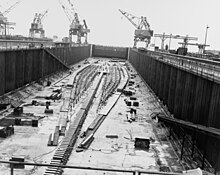
USSUnited States, pictured in drydock with her keel laid. The cancellation of Usa and her sister ships was a major factor in the "Revolt of the Admirals"
The flush deck carrier was given the designation Project 6A. Since the bombers would be too large to fit in a hangar, Mitscher suggested that it be dispensed with, but the designers added a 28-foot (8.five thou) 1 and so it could besides comport 80 McDonnell F2H Banshee jet fighters. They calculated that 24 Douglas A3D Skywarrior bombers would require a flying deck 1,125 anxiety (343 m) long and 132 feet (40 m) wide; this was reduced to 1,050 by 113 feet (320 by 34 m) and then it would fit into the Navy's largest dry docks. It was estimated that a carrier of this size would have a full load deportation of upward to 80,000 long tons (81,000 t).[64] Although the proposed 6A carrier was only 100 feet (xxx thou) longer than the Midwaydue south, its size and radical advent led the media to refer to it as a "supercarrier". The plan was that the Navy's aircraft carriers would operate in four carrier strike groups, each with a 6A, a Midway-class and ii Essex-class aircraft carriers (since there were only iii Midwaysouth, 1 grouping would take a third Essex in lieu).[66] Iv 6A carriers were therefore slated to be built, with one laid down each yr from 1949 to 1952, with all four operational by 1955.[67] The ship'southward characteristics were approved by Nimitz as CNO on 2 September 1947, and past the acting Secretarial assistant of the Navy, W. John Kenney, the post-obit day.[68]
The starting time 6A represented a $189 million line item (equivalent to $1.66 billion in 2020) in a $14 billion defense upkeep (equivalent to $123 billion in 2020), and that was inevitably going to attract the attending of the Bureau of the Budget. On 16 December 1947, its manager, James E. Webb, stated that he was opposed to the 1949 shipbuilding plan due to its toll. Sullivan offered to cancel the battleship USSKentucky and battlecruiser USSHawaii to assure funds for the 6A carrier, and Webb informed Sullivan that he and Truman had accepted the shipbuilding plan on that basis on xix December.[68] The Joint Chiefs' approval was not sought in 1947, considering the new unification constabulary had non however been enacted. In testimony before Congress in May 1948, Sullivan and Denfeld said that the 6A carrier had the approval of the Joint Chiefs, the Secretary of Defense and the President. General Carl Spaatz, the retired Chief of Staff of the Air Force, objected; the Articulation Chiefs had never canonical information technology. Forrestal then submitted information technology to the Joint Chiefs for their approving on 26 May 1948. Leahy, Denfeld and the Master of Staff of the Army, General Omar N. Bradley, approved it; Vandenberg refused to practice and then.[69] Congress funded the 6A carrier equally part of the shipbuilding program on 24 June 1948, and Forrestal gave his approval on 22 July, giving the offset 6A carrier the designation CVA-58, and Truman authorized the shipbuilding program the following twenty-four hours.[lxx] The keel of the send, which was named the USSUnited States, was laid at Newport News, Virginia, on 23 Apr 1949.[71] [72]
Forrestal did not back up Truman's 1948 Presidential campaign; instead, he met with Truman's opponent, Thomas E. Dewey, with whom he discussed the possibility of remaining in cabinet in a Republican administration. Truman was angered past this, and on two March 1949, subsequently he won the election, he announced that Forrestal was existence replaced past Louis A. Johnson, who had raised $1.5 million for Truman's re-election entrada.[73] [74] On 22 May, Forrestal committed suicide past self-defenestration.[73] Johnson had no qualms over supporting Truman's military budget reductions and fiscally preferred the Air Force's argument. His idea of an executive was someone who gave orders, and those orders were to exist carried out immediately and without question. When the naval officers questioned his decisions on weapons and strategy (such every bit the cancellation of the United States), he took that every bit a sign of insubordination. When attacks appeared against his character, he wanted those responsible severely punished.[75]
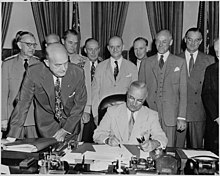
Johnson sought the opinions of General of the Army Dwight Eisenhower, the three service secretaries and the Articulation Chiefs on the advisability of continuing the construction of the U.s.. Bradley and Vandenberg urged its counterfoil,[76] although Bradley had been in favor of the carrier the previous year.[77] On 23 Apr 1949 Johnson canceled the United States; Truman concurred with the decision.[76] [78] This vessel was the symbol and hope for the Navy's hereafter, and its counterfoil greatly demoralized the service.[71] Sullivan met with Truman on 25 April and submitted his resignation to Johnson the following day.[79] Johnson did not seem disturbed. His decision to abolish United States provided him with economy in the war machine upkeep needed to meet his monetary goals, while demonstrating that he was in firm command of the military and able to make hard decisions.[76]
To supersede Sullivan, Johnson recommended Francis P. Matthews for the position of Secretary of the Navy. A lawyer from Omaha, Nebraska, he had served equally a director of the United Service Organizations (USO), a service organization that entertained the troops. He came to the attention of Johnson by profitable him with political fund raising for the 1948 Truman campaign.[lxxx] [81] Matthews admitted the nearest he had come to naval feel was rowing a boat on a lake.[82] He was sworn in on 25 May 1949.[80] [81] Another change that month was the departure of Radford, who became Commander in Main Pacific (CINCPAC), and was replaced as VCNO by Vice Admiral John D. Cost.[83] On 10 Baronial, Truman signed amendments to the National Security Act, which created the new position of Chairman of the Joint Chiefs of Staff, and he appointed Bradley to the position.[84]
A research group, OP-23, a naval intelligence unit formed in December 1948 by Denfeld to propose him on unification and afterwards headed by Captain Arleigh Burke, had been gathering information to help defend the Navy's position, including material critical of the B-36'southward performance and capabilities.[85] In April 1949 what became known equally the Anonymous Document appeared. Information technology pointed out that prior to his posting as Secretary of Defense Johnson had been on the lath of directors of Convair, the manufacturer of the B-36 bomber, and was the caput of Convair's police house. The certificate highlighted his apparent conflict of interest in representing the regime with this manufacturer. It went on to claim that the B-36 was a "billion-dollar blunder" and alleged "fraud" on the office of B-36 contractors regarding costs, capabilities and examination results.[86] [87] The certificate was sent to Glenn L. Martin, the chairman of the Glenn L. Martin Company, and several members of Congress.[88]
Congressional hearings [edit]

At start there was fiddling sign that Congress would conduct an investigation of the Bearding Document. Senator Millard Tydings, the Chairman of the Senate Armed Service Commission, was a close friend of Martin's, but was wary of the contents of the Anonymous Document. Carl Vinson, the Chairman of the House Military machine Commission had concerns about the ongoing publicity campaigns of the Navy and Air Force, particularly the leaking of classified data. This included the publication by a United Press reporter, Charles W. Corddry, that the Us was targeting seventy Soviet cities for strategic bombardment. With the influential Tydings unwilling to act, Congressman James Van Zandt introduced a resolution in the House of Representatives on 25 May 1949 calling for an investigation of contract awards and cancellations. Vinson saw this every bit a challenge to his say-so, and on 1 June submitted his ain resolution that the House War machine Committee exist authorized to conduct an investigation into the procurement of the B-36. The House adopted Vinson'due south resolution on eight June.[89]
The first stage of the Business firm War machine Commission hearing and investigation on "Unification and Strategy" was held from 9 to 25 Baronial 1949. The focus was on the allegations of fraud and corruption emanating from the Anonymous Document.[90] The author of the "anonymous document" was determined to be Cedric R. Worth, a quondam Navy commander serving every bit a civilian banana to Nether Secretarial assistant of the Navy Dan A. Kimball.[87] Worth was called every bit a witness and testified before the House Investigating Committee. The committee found no substance to charges of improper involvement in shipping procurement on the part of Johnson or Symington.[91] The Air Force was exonerated of all charges of wrongdoing. At the decision, the committee recommended that Worth be fired. Post-obit a naval court of inquiry, Worth was dismissed. The apparent vindication of Secretary Johnson and inappropriate piece of work by Worth was an embarrassment to the Navy.[92]
On hearing word of proposed cuts to the Navy upkeep, a naval aviator serving on the Articulation Staff, Captain John G. Crommelin, chosen an impromptu press conference in which he claimed that unification had been a mistake, and that Johnson was out to destroy the Navy. Denfeld did not respond direct to Crommelin's remarks, taking the position that naval officers were complimentary to express their personal opinions. Matthews felt differently; he issued a statement to the effect that Crommelin'due south actions rendered him unfit to proceed serving on the Joint Staff. Accordingly, he was transferred to a billet on Denfeld'southward staff normally held by a rear admiral. Matthews was furious, and Denfeld quickly moved Crommelin to a more than junior mail service. Matthews and Denfeld and then issued a guidance memorandum that stated that speeches and articles for public release had to exist cleared through the Function of the Secretary of the Navy.[93]
Matthews had requested communication from senior personnel on issues facing the Navy that might come up in hearings, so Bogan, now the Commander of the Outset Task Fleet in the Pacific, wrote to Matthews on 20 September to inform him of the state of morale in the Navy, which he described equally "lower today than at whatever time since I entered the commissioned ranks in 1916",[94] and he expressed support for Crommelin's views. The letter was confidential, but Radford, as CINCPAC, and Denfeld, as CNO, reviewed the letter as it was routed through official channels to Matthews'due south office. In his endorsement, Denfeld concurred with the sentiments that Bogan expressed.[94]
A second hearing convened in October focused upon the proposed reduction in the Navy and the cancellation of the United States and the soundness of the proposed expansion of the strategic bomber forces. They were given added urgency by Truman's announcement on 23 September that the Soviet Spousal relationship had tested its start nuclear device.[95] Matthews announced that no Navy man would be censored or penalized for the testimony he offered at the hearing.[96] This should have been unnecessary, since it was illegal to threaten witnesses testifying earlier Congress or to accept activeness against them afterwards. Notwithstanding, when Vinson opened the hearings on 6 October he declared:
It is the intent of the Committee that all testimony given shall exist frankly and freely given and exist given without reprisals in the Section of Defence against any individual presenting testimony during the course of these hearings. The committee volition non permit nor tolerate whatsoever reprisal against any witness in these hearings nor volition it permit or tolerate whatsoever shepherding of the testimony beingness presented. We want these witnesses to speak what is in their minds, to put their cards on the table, and to do so without hesitation or personal business concern. We are going to the bottom of this unrest and business in the Navy. And the committee expects total cooperation in this from the Department of Defense force.[97]

The naval officers called to testify were expected to support Secretarial assistant Matthews, but instead officer afterwards officer arose to testify that the Air Forcefulness reliance on the B-36 was inadequate, and that the entire strategy of atomic bombing was immoral and misguided.[98] Among the officers testifying from 6 to 17 October, were the naval leaders of World War Two: Armada Admirals Ernest King, Chester Nimitz and William Halsey, Admirals Raymond Spruance and Thomas Kinkaid, and General Alexander Vandegrift, the onetime Commandant of the Marine Corps.[99] Burke had run tests which showed the Navy was already in possession of a fighter aircraft, the F2H Banshee, that could reach high enough altitudes to intercept bombers like the B-36, and he knew it would exist unreasonable to assume that an opposing major world power would non too take developed such an aircraft. In that example, the B-36 would need to be accompanied with long-range fighter escorts with the requisite range and ceiling to complete its mission, and the Air Force had no such fighter bachelor in their inventory.[96] In his testimony, Denfeld broadly supported the Navy officers who had testified earlier him.[100]
Symington and Vandenberg rebutted the admirals' testimony, point past signal, on 18 and 19 October.[101] Regarding the Us, Vandenberg commented: "I take the military capability of this send as stated past the Chief of Naval Operations. My opposition to edifice it comes from the fact that I can see no necessity for a send with those capabilities in any strategic plan against the one possible enemy."[102] Symington denied that the Air Force favored the bombing of civilians or that information technology believed that an atomic blitz offered a "quick, easy and painless war".[103] Vandenberg testified that "Veterans of the Eighth, the Fifteenth, the Twentieth and other celebrated Air Forces know very well that there are no cheap and easy ways to win bang-up wars."[104] He said that during World State of war 2 bombers had always managed to become through to their targets, and that technological improvements since and so fabricated it still more likely. He was optimistic in his testimony, although he had reason for concern, having received a memo from Major General Gordon P. Saville that only 1 B-36 had so far attempted a radar-controlled bombing run from 40,000 anxiety (12,000 chiliad).[105]
The remainder of the testimony before the House Armed Services Commission was from one-time President Herbert Hoover, Johnson, and Generals of the Regular army George C. Marshall, Dwight Eisenhower and Omar Bradley on the claim of unification.[106] Bradley noted that he had participated in the ii largest amphibious operations in history, namely the invasions of Sicily and Normandy,[107] and confidently predicted that "big-scale amphibious operations, such as those in Sicily and Normandy, will never occur again".[108] He made no attempt to hibernate his contempt for the Navy's methods during the instance, and he defendant senior naval officers of poor leadership and disloyalty:
Our military forces are i team – in the game to win regardless of who carries the ball. This is no time for "fancy dans" who won't hit the line with all they have on every play, unless they can call the signals. Each player on this team – whether he shines in the spotlight of the backfield or eats dirt on the line – must be an all-American.[109]

The House Armed forces Committee found a number of actions taken by the assistants and past the services involved to be overstepping. It held that evaluation of the B-36's worth was the responsibility of the Weapons Systems Evaluation Grouping, and that the services jointly should non pass judgment on weapons proposed by one service. On cancellation of the supercarrier, the committee questioned the qualifications of the Army and Air Force chiefs of staff, who had testified in support of Johnson'southward decision, to decide vessels appropriate for the Navy. In disapproving of Johnson'southward "summary manner" of terminating the carrier and his failure to consult congressional committees before acting, the committee stated that "national defense is non strictly an executive department undertaking; it involves not only the Congress simply the American people as a whole speaking through their Congress. The commission can in no way condone this manner of deciding public questions."[110] The commission expressed solid back up for effective unification, but stated that "at that place is such a thing as seeking as well much unification too fast" and observed that "in that location has been a navy reluctance in the inter-service marriage, an over-ardent army, a somewhat exuberant air force ... It may well be stated that the committee finds no unification Puritans in the Pentagon."[110]
During the hearings public opinion shifted strongly against the Navy. Time mag noted: "Even so staunch a friend of the Navy as the New York Times Annapolis-trained military machine analyst Hanson Baldwin wrote that he himself did not consider the cutbacks in the Navy program disastrous. Baldwin added dryly: 'Some of the Navy'southward interest in morality equally applied to strategic bombing seems new-found.'"[104] The whole episode became known as the "Revolt of the Admirals".[104] [111]
Outcome [edit]
After the hearings, Secretary Matthews ready about punishing those officers who had testified and were all the same actively serving in the Navy, in defiance of his own public hope not to do so.[96] Denfeld was first to go; he was summarily relieved by Truman on what had been Navy Day, 27 Oct 1949. Matthews explained that he and Denfeld disagreed widely on strategic policy and unification.[112] Denfeld retained his rank, and was offered the postal service of Commander in Master of the Naval Forces in the Eastern Atlantic and Mediterranean,[113] but he declined and elected to retire instead.[114] Matthews selected Sherman equally his new CNO.[115] Bogan was given command of Fleet Air at Naval Air Station Jacksonville, a billet normally filled past a rear admiral. He likewise elected to retire rather than face up consignment to a position of bottom authority.[114] Crommelin continued to openly speak out and was forced into retirement by Sherman.[116]
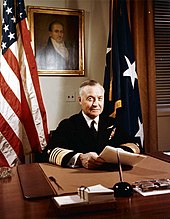
One of Sherman'south outset deportment as CNO was to disband OP-23, simply non before the Naval Inspector Full general's function seized all documents in search of bear witness tying it to Crommelin'due south disclosures or breaches of security.[117] Matthews and Johnson attempted to block the promotion of Burke by crossing out his name on the promotion list, but this was seen and reversed past Truman.[118] The House Armed Services Committee condemned Denfeld's dismissal, concluding that:
the removal of Admiral Denfeld was a reprisal against him for giving testimony to the House Armed Services Commission. This deed is a blow against effective representative authorities in that it tends to intimidate witnesses and hence discourages the rendering of free and honest testimony to the Congress; information technology violated promises made to the witnesses by the Committee, the Secretarial assistant of the Navy, and the Secretary of Defense; and information technology violated the Unification Act, into which a provision was written to specifically foreclose deportment of this nature against the Nation's highest military and naval officers.[119]
The Truman administration won the conflict with the Navy, and civilian control over the military was reaffirmed. Military budgets following the hearings prioritized the development of Air Strength heavy bomber designs. These were deployed across the country and at dozens of overseas bases.[118] Frank Stride, who as Managing director of the Bureau of the Upkeep had been a driving force backside defense cuts, was appointed Secretary of the Army, and Leon Keyserling, a Keynesian economist, replaced Edwin Nourse as the chairman of the Council of Economic Advisers when the latter quit over the administration'south failure to cut spending.[120] Johnson authorised the modernisation of ii Essex-form shipping carriers, increasing the Navy's projected aircraft carrier strength in fiscal twelvemonth 1951 to seven, but a committee he established to look for farther economies suggested another $929 one thousand thousand in cuts to the fiscal year 1950 upkeep, mainly at the expense of the Army and Navy budgets, which were cut by some other $357 million and $376 million respectively. While about of Johnson's cuts came at the expense of the Navy, it was the Army that was affected the most. Afterwards a year with Johnson at the helm, the Regular army had lost 100,000 men and only ane of its x divisions was at total forcefulness.[121] [122] Truman still talked nigh cutting the defense upkeep to $9 billion.[122] Unwilling to support farther cuts, Symington submitted his resignation in April 1950.[123]

On 25 June 1950, the Korean War broke out and the assistants was forced to confront the crunch with the forces it had on hand. The Truman administration immediately decided not to apply the nuclear arsenal, and sought to check the Northward Korean advance with conventional forces.[124] The war discredited the proponents of austerity and vindicated the hawks that had called for increased defense spending.[125] As an initial response, Truman called for a naval blockade of Northward Korea, and was shocked to acquire that such a blockade could only be imposed "on newspaper", since the Navy no longer had the warships with which to carry out his asking.[126] Faced with public criticism of his handling of the Korean War, which opened with a series of setbacks and defeats, and wishing to deflect blame from the peacetime defence economy measures he had espoused, Truman decided to ask for Johnson'due south resignation on nineteen September 1950. Truman decided he needed a Secretary of Defense that had the conviction of all 3 services, preferably i with significant military experience, and nominated George Marshall.[124] [125] Matthews resigned on 31 July 1951, and became the United States Ambassador to Ireland.[127]
The Korean War compelled a reluctant Truman to loosen the purse strings. The administration did non determine betwixt military machine and civilian spending; information technology establish that it could afford both.[128] No solution for inter-service rivalry or any process for the resolution of competing budgetary claims emerged.[129] Rivalry betwixt the services was not concluded; what concluded was contest over a zero-sum budget. Defence outlays quadrupled between 1950 and 1953. In fiscal year 1951, the Ground forces had double the manpower called for in Johnson's budget; the Navy increased its carrier force from 15 to 27; and Air Force grew from 48 wings to 87. Fears of inflation proved unfounded; although it increased to 7.9 percent in 1951, it dropped back to below i percent the following yr.[125] Between 1954 and 2002, annual defense outlays averaged $317.seven billion in 2002 dollars, nearly 1.5 times the average betwixt 1947 and 1950. Betwixt 1948 and 1986, the Air Force's share of the defense force budget was 35 percent, the Navy's 31 percent, and the Army's 28 percent.[130]
The Navy did go a supercarrier; Johnson approved its construction on 22 June 1950. Launched in October 1955, the USSForrestal,[124] at lx,000 long tons (61,000 t) was ane.5 times the size of the Midway-form aircraft carriers. She featured an armoured flight deck just large plenty and sturdy enough to land a heavy bomber carrying a pocket-size nuclear bomb. The transport was also equipped with steam catapults to aid the heavier nuclear bombers in getting airborne. The flight deck was angled, allowing the new carrier to launch and recover aircraft at the same time, and obviating the need for a flush deck.[131] The AJ Savages were mostly based ashore. With the development of smaller and lighter nuclear weapons in the tardily 1950s, it became possible for them to be carried by standard Navy assault planes.[132]
See also [edit]
- Civilian control of the military machine
- Interservice rivalry
Notes [edit]
- ^ a b c Wolk 1996, pp. viii–11.
- ^ Cole et al. 1978, p. iii.
- ^ a b c d Toprani 2019a, p. 124.
- ^ Wolk 1996, pp. 18–20.
- ^ McFarland 1980, p. 54.
- ^ Wolk 1996, pp. 23–24.
- ^ Wolk 1996, pp. 28–xxx.
- ^ Toprani 2019a, p. 123.
- ^ "Sullivan, John L. Papers". Harry S. Truman Presidential Library. Retrieved 17 August 2020.
- ^ a b Wolk 1996, pp. 31–33.
- ^ Toprani 2019a, p. 126.
- ^ a b Toprani 2019a, pp. 126–128.
- ^ Stanton 1984, p. iii.
- ^ a b c Rearden 1984, p. 12.
- ^ Moody 1995, p. 61.
- ^ Schnabel 1996, pp. lxx–77.
- ^ "Admiral Louis E. Denfeld". Naval History and Heritage Command. 15 July 2016. Retrieved xiii September 2020.
- ^ Ross 1988, pp. 72–74.
- ^ Ross 1988, pp. 98–99.
- ^ Barlow 2001, pp. xi–xiii.
- ^ Barlow 2001, pp. thirteen–17.
- ^ Barlow 2001, pp. 17–twenty.
- ^ Wolk 1988, p. 13.
- ^ Barlow 2001, p. 21.
- ^ Smith 1948, p. 6.
- ^ Smith 1949, p. 68.
- ^ Curatola 2016, pp. 106–107.
- ^ Abrahamson & Carew 2002, pp. 67–69.
- ^ Lilliputian 1955, pp. 391–392.
- ^ Campbell 2005, pp. 61–62.
- ^ Moody 1995, p. 169.
- ^ Moody 1995, p. 109.
- ^ Smith 1947, pp. 3–viii.
- ^ Knaack 1988, p. 490.
- ^ a b Curatola 2016, pp. 108–109.
- ^ Knaack 1988, pp. 3–5.
- ^ Knaack 1988, pp. 8–12.
- ^ Futrell 1989, p. 240.
- ^ Knaack 1988, p. xx.
- ^ Knaack 1988, pp. 13–14.
- ^ a b c Futrell 1989, pp. 240–242.
- ^ a b Toprani 2019a, p. 129.
- ^ Futrell 1989, pp. 242–245.
- ^ Rosenberg & Kennedy 1975, pp. ii–4.
- ^ a b c d Toprani 2019b, p. 685.
- ^ a b Toprani 2019a, pp. 123–124.
- ^ Toprani 2019b, pp. 683–684.
- ^ a b Barlow 2001, p. 6.
- ^ Rosenberg & Kennedy 1975, pp. 5–7.
- ^ Barlow 2001, p. eight.
- ^ FitzSimonds 2020, pp. 843–844.
- ^ FitzSimonds 2020, pp. 846–848.
- ^ Rosenberg & Kennedy 1975, p. 13.
- ^ a b c d Barlow 2001, pp. 117–120.
- ^ a b c d Miller 2001, pp. 33–35.
- ^ Steele 2010, pp. 278–280.
- ^ Barlow 2001, p. 326.
- ^ Miller 2001, pp. 30–33.
- ^ Hansen 1995, pp. 116–118.
- ^ Friedman 1983, p. 248.
- ^ Hayward & Borklund 2000, p. 183.
- ^ Steele 2010, pp. 273–275.
- ^ Toprani 2019b, p. 686.
- ^ a b Friedman 1983, pp. 239–243.
- ^ Toprani 2019a, p. 125.
- ^ Rosenberg & Kennedy 1975, pp. 44–45.
- ^ Barlow 2001, p. 143.
- ^ a b Barlow 2001, p. 141.
- ^ Barlow 2001, p. 142.
- ^ Barlow 2001, p. 144.
- ^ a b McFarland 1980, p. 56.
- ^ Barlow 2001, p. 184.
- ^ a b Wooley, Alex (23 May 1999). "The Fall Of James Forrestal". The Washington Post . Retrieved 27 Baronial 2020.
- ^ McFarland 1980, pp. 54–55.
- ^ Toprani 2019a, p. 131.
- ^ a b c McFarland 1980, pp. 55–57.
- ^ Barlow 2001, p. 186.
- ^ Potter 2005, p. 311.
- ^ Barlow 2001, pp. 188–191.
- ^ a b Potter 2005, p. 320.
- ^ a b Barlow 2001, pp. 205–206.
- ^ "The Assistants: Off to Ireland". Fourth dimension. 9 July 1951. Retrieved xviii September 2020.
- ^ Barlow 2001, pp. 194–195.
- ^ Condit 1996, p. 149.
- ^ Steele 2010, p. 314.
- ^ Steele 2010, p. 308.
- ^ a b McFarland 1980, p. 58.
- ^ Barlow 2001, pp. 207–210.
- ^ Barlow 2001, pp. 216–217.
- ^ Potter 2005, p. 321.
- ^ McFarland 1980, p. 59.
- ^ Potter 2005, p. 322.
- ^ Barlow 2001, pp. 235–236.
- ^ a b Barlow 2001, pp. 236–237.
- ^ Barlow 2001, p. 233.
- ^ a b c Potter 2005, p. 324.
- ^ Freund 1963b, p. 37.
- ^ Barlow 2001, pp. 247–250.
- ^ Barlow 2001, p. 250.
- ^ Barlow 2001, p. 253.
- ^ Barlow 2001, pp. 256–257.
- ^ Wolk 1988, p. 67.
- ^ Barlow 2001, p. 255.
- ^ a b c "Revolt of the Admirals". Time. 17 October 1949. Retrieved 28 Baronial 2020.
- ^ Barlow 2001, p. 257.
- ^ Freund 1963a, p. 5.
- ^ Barlow 2001, p. 202.
- ^ Steele 2010, p. 342.
- ^ Freund 1963a, p. iv.
- ^ a b "Louis A. Johnson". Historical Office, Office of the Secretary of Defense force. Department of Defense. Retrieved 27 August 2020.
- ^ Freund 1963a, p. ii.
- ^ Barlow 2001, p. 365.
- ^ Barlow 2001, pp. 274–275.
- ^ a b Barlow 2001, p. 282.
- ^ Barlow 2001, pp. 270–271.
- ^ Barlow 2001, pp. 282–283.
- ^ Barlow 2001, pp. 277–278.
- ^ a b McFarland 1980, p. 61.
- ^ Congressional Tape: Proceedings and Debates of the 81st Congress, second Session. Vol. 96, Part 3. Washington, D.C.: United States Congress. 1950. p. 2893. Retrieved 14 September 2020.
- ^ Toprani 2019b, p. 694.
- ^ Toprani 2019a, pp. 133–134.
- ^ a b Toprani 2019b, p. 691.
- ^ Whynot 1997, p. 222.
- ^ a b c McFarland 1980, p. 62.
- ^ a b c Toprani 2019b, p. 696.
- ^ "Memorandum of Data for the Secretarial assistant — Blockade of Korea". Truman Presidential Library — Archives. 6 July 1950. Archived from the original on 9 August 2007. Retrieved 28 July 2007.
- ^ "Matthews, Francis P." Naval History and Heritage Command. Retrieved five October 2020.
- ^ Toprani 2019b, pp. 695–696.
- ^ Toprani 2019a, pp. 141–142.
- ^ Toprani 2019b, p. 697.
- ^ Friedman 1983, pp. 261–268.
- ^ Rosenberg & Kennedy 1975, p. 176.
References [edit]
- Abrahamson, James L.; Carew, Paul H. (2002). Vanguard of American Atomic Deterrence. Westport, Connecticut: Praeger. ISBN0-275-97819-2. OCLC 49859889.
- Barlow, Jeffrey G. (2001). Revolt of the Admirals: The Fight for Naval Aviation, 1945–1950. Washington, D.C.: Naval Historical Middle. ISBN1-931641-13-vii. OCLC 317410844.
- Campbell, Richard H. (2005). The Silverplate Bombers: A History and Registry of the Enola Gay and Other B-29s Configured to Carry Atomic Bombs. Jefferson, N Carolina: McFarland & Company. ISBN0-7864-2139-8. OCLC 58554961.
- Cole, Alice C.; Goldberg, Alfred; Trucker, Samuel A.; Winnacker, Rudolph A., eds. (1978). The Department of Defense: Documents on Establishment and Organization, 1944–1978 (PDF). Washington, D.C.: Office of the Secretary of Defence, Historical Office. OCLC 18171884. Retrieved xiv Baronial 2020.
- Condit, Kenneth Westward. (1996). The Joint Chiefs of Staff and National Policy, Book Ii: 1947–1949 (PDF). History of the Joint Chiefs of Staff. Washington, D.C.: Office of Articulation History Role of the Chairman of the Articulation Chiefs of Staff. OCLC 4651413. Retrieved 30 April 2020.
- Curatola, John M. (2016). Bigger Bombs for a Brighter Tomorrow: The Strategic Air Command and American War Plans at the Dawn of the Atomic Age, 1945–1950. Jefferson, North Carolina: McFarland. ISBN978-0-7864-9419-4. OCLC 927620067.
- FitzSimonds, James R. (July 2020). "Aircraft Carriers versus Battleships in War and Myth: Demythologizing Carrier Air Dominance at Sea". Journal of Military History. 84 (3): 843–865. ISSN 0899-3718.
- Freund, James C. (January 1963). "A Bureaucratic Response to a Conflict in Involvement: Office One: The "Revolt of the Admirals": A Study of the 1949 Congressional Hearings on Unification and Strategy". The Air Power Historian. 10 (1): 1–ten. ISSN 0277-9048. JSTOR 44513207.
- Freund, James C. (Apr 1963). "A Bureaucratic Response to a Conflict in Interest: Role Two: The "Revolt of the Admirals": A Study of the 1949 Congressional Hearings on Unification and Strategy". The Air Ability Historian. x (two): 37–42. ISSN 0277-9048. JSTOR 44513423.
- Friedman, Norman (1983). U.South. Shipping Carriers: An Illustrated Design History. Annapolis, Maryland: Naval Institute Press. ISBN978-0-87021-739-5. OCLC 924804258.
- Futrell, Robert Frank (1989). Ideas, Concepts, Doctrine: Basic Thinking in the U.s. Air Force 1907-1960 (PDF). Maxwell Air Strength Base of operations, Alabama: Air Academy Press. OCLC 954232808. Retrieved 24 Baronial 2020.
- Hansen, Chuck (1995). Volume V: U.s.a. Nuclear Weapons Histories. Swords of Armageddon: Usa Nuclear Weapons Evolution since 1945. Sunnyvale, California: Chuckelea Publications. ISBN978-0-9791915-0-three. OCLC 231585284.
- Hayward, John T.; Borklund, C.W. (2000). Bluejacket Admiral: The Naval Career of Chick Hayward. Annapolis, Maryland: Naval Institute Press. ISBN978-1-55750-189-9. OCLC 43411582.
- Knaack, Marcelle Size (1988). Encyclopedia of U.S. Air Strength Aircraft and Missile Systems: Volume 2: Post-World War II Bombers, 1945–1973 (PDF). Washington, DC: Office of Air Force History. ISBN0-912799-59-five. OCLC 631301640. Retrieved 5 May 2020.
- Lilliputian, Robert D. (1955). Foundations of an Atomic Air Force and Operation Sandstone 1946–1948 (PDF). The History of Air Force Participation in the Diminutive Energy Program, 1943–1953. Vol. Two. Washington, D.C.: U.South. Air Force, Air Academy Historical Liaison Office. Archived from the original (PDF) on 4 March 2016. Retrieved 28 July 2013.
- McFarland, Keith (1980). "The 1949 Revolt of the Admirals" (PDF). Parameters: Periodical of the US Army War College Quarterly. XI (two): 53–63. ISSN 0031-1723. Retrieved 12 August 2020.
- Miller, Jerry (2001). Nuclear Weapons and Aircraft Carriers: How the Bomb Saved Naval Aviation. Washington and London: Smithsonian Establishment Press. ISBNone-56098-944-0. OCLC 231874559.
- Moody, Walton S. (1995). Building a Strategic Air Force (PDF). Washington, D.C.: Air Force History and Museums Program. OCLC 1001725427. Retrieved 2 May 2020.
- Potter, E. B. (2005). Admiral Arleigh Burke. Annapolis, Maryland: Naval Institute Press. ISBN978-ane-59114-692-6. OCLC 56419322.
- Rearden, Steven L. (1984). The Formative Years 1947–1950 (PDF). History of the Office of the Secretary of Defence force. Washington, D.C.: Historical Office, Office of the Secretary of Defense. OCLC 1096666315. Retrieved fourteen September 2020.
- Ross, Steven T. (1988). American War Plans 1945–1950. New York and London: Garland. ISBN0-8240-0207-5. OCLC 242582147.
- Rosenberg, David A.; Kennedy, Floyd D. Jr. (Oct 1975). The states Aircraft Carriers in the Strategic Office (Report). History of the Strategic Arms Competition 1945-1972. Falls Church building, Virginia: Lelujan and Assembly. 1679163694 – via ProQuest.
- Schnabel, James F. (1996). The Articulation Chiefs of Staff and National Policy, Volume I: 1945–1947 (PDF). History of the Joint Chiefs of Staff. Washington, DC: Role of Joint History Office of the Chairman of the Articulation Chiefs of Staff. OCLC 227843704. Retrieved xxx April 2020.
- Smith, Dale O. (Fall 1947). "One-Manner Combat" (PDF). Air University Quarterly. one (ii): iii–8. ISSN 2692-4307. Retrieved 5 February 2021.
- Smith, Dale O. (Fall 1948). "Operational Concepts for Modern War". Air Academy Quarterly. 2 (2): iii–14. ISSN 2692-4307. Retrieved 21 August 2020.
- Smith, Dale O. (February 1949). "Forgotten Weapon — The Atomic Bomb". Flying. Vol. 44, no. ii. pp. 21–23, 68–71. ISSN 0015-4806.
- Stanton, Shelby L. (1984). Order of Battle: U.S. Army World War 2 . Novato, California: Presidio Printing. ISBN0-89141-195-Ten. OCLC 464157998.
- Steele, Patrick Westward. (May 2010). Strategic Air Warfare and Nuclear Strategy: the Formulation of Military Policy in the Truman Administration, 1945–1950 (PhD thesis). Marquette University. OCLC 881117204. Retrieved 26 Baronial 2020.
- Toprani, Anand (2019a). "Budgets and Strategy: The Indelible Legacy of the Revolt of the Admirals". Political Science Quarterly. 134 (1): 117–146. doi:10.1002/polq.12870. ISSN 0032-3195.
- Toprani, Anand (2019b). "'Our Efforts Have Degenerated into a Contest for Dollars'. The 'Revolt of the Admirals', NSC-68, and the Political Economy of the Cold War". Diplomacy and Statecraft. thirty (4): 681–706. doi:10.1080/09592296.2019.1670998. ISSN 0959-2296. S2CID 213854550.
- Wolk, Herman (1996). Toward Independence: The Emergence of the U.S. Air Strength 1945-1947 (PDF). Washington, DC: Air Strength History and Museums Programme. OCLC 35746411. S2CID 107567473. Retrieved xiv Baronial 2020.
- Wolk, Herman (May 1988). "Revolt of the Admirals". Air Force Mag. ISSN 1943-4782. Retrieved ii May 2014.
- Whynot, Wyndham Eric (1997). Architect of a Modern Air Force: W. Stuart Symington'south Role in the Institutional Development of the National Defence force Establishment, 1946–1950 (PhD thesis). Kent State University. OCLC 40734269.
Further reading [edit]
- Dittmer, David Bruce (Apr 1995). The Firing of Admiral Denfeld: An Early on Casualty of the Military Unification Procedure (MA thesis). University of Nebraska at Omaha. Retrieved 18 August 2020.
Source: https://en.wikipedia.org/wiki/Revolt_of_the_Admirals

Post a Comment for "Large scale Amphibious Operations Will Never Occur Again Omar Bradley"